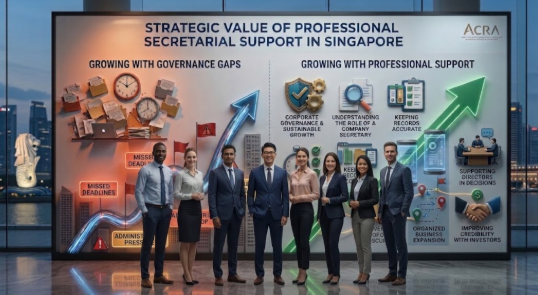
Business growth is usually associated with increasing revenue, attracting customers, entering new markets, and expanding operations. However, sustainable growth also depends on something that often receives less attention: strong corporate governance. As a company develops, its legal responsibilities become more complex, and maintaining accurate corporate records becomes increasingly important. Without an organised approach to these responsibilities, business owners may face unnecessary administrative pressure, missed deadlines, and compliance difficulties.
Singapore is widely recognised as an attractive destination for entrepreneurs and international businesses because of its established commercial environment and regulatory framework. However, operating a company in Singapore also involves ongoing statutory obligations. Professional secretarial support helps businesses manage these responsibilities while allowing directors and management teams to concentrate on strategic priorities.
Understanding the value of company secretary services singapore can help business owners recognise why corporate administration should be treated as an essential part of their growth strategy rather than an occasional administrative task.
1. Corporate Governance Is Essential for Sustainable Growth
Corporate governance refers to the systems, responsibilities, and procedures used to direct and manage a company. It establishes how important decisions are made, how responsibilities are distributed, and how the organisation maintains accountability.
For a newly established business, governance may initially appear straightforward. A small management team can communicate directly, make decisions quickly, and maintain basic records without extensive administrative support. However, as the organisation expands, additional shareholders, directors, employees, and business relationships can make internal administration more complicated.
Without proper procedures, important decisions may not be documented correctly, corporate information may become outdated, and statutory deadlines may be overlooked.
A professional company secretary helps establish organised processes that support transparency, consistency, and responsible corporate management.
2. Understanding the Role of a Company Secretary in Singapore
In Singapore, a company secretary performs an important statutory and administrative role. Under the Companies Act, a company must appoint at least one company secretary within six months of incorporation.
The appointed secretary must meet the applicable eligibility requirements. For a private company, the secretary must ordinarily reside in Singapore. A sole director cannot also act as the company’s secretary.
The position involves more than maintaining documents. A company secretary supports directors in meeting their corporate responsibilities and helps ensure that important statutory procedures are followed.
Typical responsibilities may include:
- Maintaining statutory registers and corporate records.
- Preparing and maintaining minutes of board and shareholder meetings.
- Assisting with the preparation of resolutions.
- Monitoring annual filing and reporting deadlines.
- Supporting updates to company information with ACRA.
- Maintaining records of directors and shareholders.
- Providing administrative guidance on corporate governance matters.
The exact scope of work depends on the company’s requirements and the engagement agreed with the service provider.
3. Preventing Compliance Gaps Before They Become Problems
One of the most valuable contributions of professional secretarial support is the prevention of avoidable compliance issues.
Singapore companies must meet various statutory obligations throughout their operating lives. These may include filing annual returns, maintaining accurate corporate information, documenting changes in company structure, and keeping required records available.
A missed filing deadline or an unreported corporate change can create additional administrative work and may expose the company to penalties or regulatory consequences.
Professional secretarial support introduces a more structured approach to these responsibilities. Important dates can be monitored through compliance calendars, while document preparation and submission procedures can be organised in advance.
This proactive approach reduces the likelihood of last-minute administrative pressure and allows directors to focus on running the business.
4. Keeping Corporate Records Accurate and Accessible
Corporate records provide an official history of a company’s structure, decisions, and important developments. They may be required when dealing with banks, investors, auditors, regulators, or potential business partners.
For example, a company may need to demonstrate who its current directors and shareholders are, when particular decisions were approved, or whether a change in shareholding was properly recorded.
Disorganised records can make these tasks unnecessarily difficult. Missing resolutions, outdated registers, and incomplete meeting minutes may create uncertainty about the company’s official position.
A professional secretary helps maintain relevant documentation and ensures that important corporate changes are recorded through the appropriate procedures.
Accurate records also support better internal communication because directors and authorised personnel can refer to documented decisions instead of relying entirely on informal discussions.
5. Supporting Directors During Important Business Decisions
Directors are responsible for managing their companies in accordance with applicable laws and their legal duties. As a business grows, directors may need to approve major decisions involving financing, share transfers, new appointments, business restructuring, or changes to company operations.
These decisions often require formal documentation and appropriate corporate procedures.
A company secretary can assist by preparing meeting notices, drafting resolutions, recording minutes, and helping directors understand the administrative steps associated with particular decisions.
This support is especially valuable when several directors or shareholders are involved. Clear documentation helps establish what was discussed, what was approved, and when the decision took effect.
Although a company secretary supports the process, directors remain responsible for exercising their own judgment and fulfilling their legal duties.
6. Making Business Expansion More Organised
Expansion introduces new opportunities, but it can also increase administrative complexity. A company entering another market, bringing in investors, issuing additional shares, or restructuring its ownership may need to complete several corporate formalities.
For example, changes to the company’s shareholding may require appropriate resolutions, updated statutory records, and filings with the relevant authority. Changes involving directors or registered company details may also require timely updates.
Professional secretarial assistance helps coordinate these administrative requirements so that important corporate changes are handled in an organised manner.
Businesses considering expansion should evaluate whether their existing governance procedures can support a larger ownership structure and more complicated decision-making arrangements.
Reliable company secretary services singapore can provide continuing administrative support as the organisation moves from a small operation towards a more established corporate structure.
7. Improving Credibility with Investors and Business Partners
Investors and commercial partners often examine more than a company’s revenue and market potential. They may also consider whether its corporate records are accurate, its ownership structure is clear, and its management follows appropriate governance practices.
A company that maintains organised documentation can generally respond more efficiently to requests for corporate information during due diligence or commercial discussions.
This does not guarantee investment or establish that a business is financially successful. However, reliable corporate administration can make the organisation easier to evaluate and help build confidence in its management processes.
For growing businesses, this can be particularly relevant when negotiating investment arrangements, applying for financing, or entering significant commercial partnerships.
8. Choosing the Right Secretarial Service Provider
Not every service provider offers the same level of support. Business owners should evaluate potential providers according to their experience, service scope, communication standards, and understanding of Singapore’s corporate regulations.
Before making a decision, consider the following factors:
Regulatory knowledge: The provider should understand Singapore’s company law requirements and the relevant ACRA filing procedures.
Service coverage: Confirm whether the service includes statutory registers, annual returns, meeting documentation, resolutions, and updates to company information.
Communication: Important deadlines and outstanding requirements should be communicated clearly and in advance.
Record management: Ask how corporate documents are prepared, stored, updated, and made available to authorised company representatives.
Transparent pricing: Understand which services are included in the quoted fee and whether additional charges apply to specific transactions.
Business owners should also confirm that the provider has the necessary qualifications, experience, and professional arrangements to deliver the agreed services.
9. Professional Support Does Not Replace Management Responsibility
Outsourcing company secretarial work can reduce administrative pressure, but it does not transfer every legal responsibility away from directors.
Directors must continue to understand their obligations, review important corporate decisions, provide accurate information, and ensure that the company operates responsibly.
The relationship between management and the company secretary should therefore be collaborative. Directors should communicate changes promptly, provide requested documents, and review important submissions before they are finalised.
When both sides understand their responsibilities, corporate administration becomes more efficient and reliable.
10. Building Governance into the Company’s Long-Term Strategy
Good governance should develop alongside the business. Companies that establish organised administrative procedures early may find it easier to manage future changes in ownership, leadership, and operations.
As the organisation grows, its governance requirements should be reviewed periodically. A structure that works for a small private company may need adjustments when the business introduces new shareholders, expands internationally, or develops more complex operations.
Regular communication with professional advisers can help identify administrative weaknesses before they become significant problems.
Instead of viewing secretarial support as a simple filing service, business owners should consider it part of the infrastructure that keeps their organisation properly documented and administratively prepared for growth.
Conclusion
Sustainable business growth requires more than strong sales and effective management. It also depends on accurate corporate records, organised decision-making, and consistent attention to statutory responsibilities.
Professional secretarial support helps Singapore companies manage these important areas while reducing the administrative burden on directors. From maintaining statutory registers to supporting board decisions and monitoring filing obligations, a capable company secretary contributes to a more structured corporate environment.
By investing in reliable governance procedures, businesses can reduce avoidable compliance gaps, strengthen their administrative foundations, and prepare for future opportunities. In a competitive commercial environment, good corporate governance is not merely a legal requirement; it is an important part of building a business that can grow with confidence.