Score first, narrate second. That is the only honest way to handle a drug like mazdutide, which gets covered almost entirely as a weight-loss story when its stronger file is arguably the glycemic one. Below is a rubric applied to the diabetes and metabolic case, then a second rubric applied to the providers a US reader can actually use in 2026, because the two questions, “is the drug good” and “can you get it,” score very differently here.
Scorecard one: the diabetes case for mazdutide
Five categories, each graded against what the record actually shows, not against marketing copy.
Mechanism (novel, plausible). Mazdutide is a once-weekly injectable peptide built from oxyntomodulin, a gut hormone that hits two receptors at once, GLP-1 and glucagon, making it the first approved dual GLP-1/glucagon agonist anywhere [1][2]. The GLP-1 half is the familiar move: more insulin when glucose is high, slower gastric emptying, less appetite. The glucagon half is the interesting variable, since glucagon normally raises blood sugar. The design bet is that the GLP-1 side keeps that tendency in check while glucagon contributes extra energy expenditure and a direct liver effect [1][2]. Innovent Biologics developed the compound under a China license from Eli Lilly; it shows up in the literature as IBI362 or LY3305677 [2]. Score: sound logic, empirically testable, and it has in fact been tested.
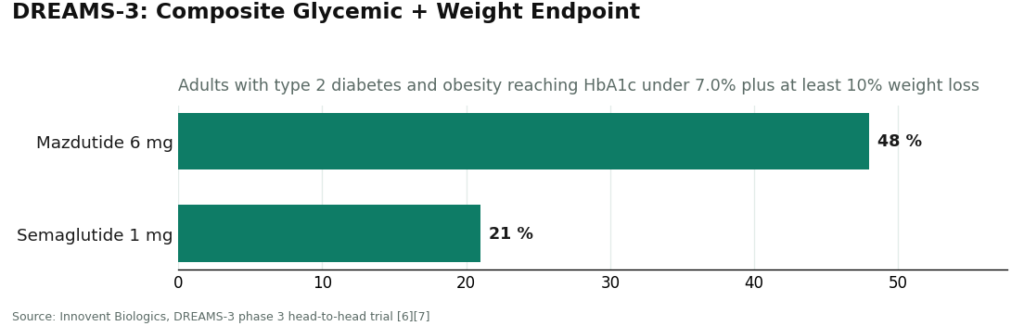
Trial evidence (strong, head-to-head). China’s National Medical Products Administration approved mazdutide for glycemic control in type 2 diabetes in September 2025, a separate approval from the June 2025 weight-management clearance [3][4]. The number that matters most is DREAMS-3, a randomized phase 3 trial pitting mazdutide directly against semaglutide in Chinese adults with type 2 diabetes and obesity. On the primary composite, HbA1c under 7.0 percent plus at least 10 percent weight loss, mazdutide 6 mg hit 48.0 percent versus semaglutide 1 mg’s 21.0 percent, with mazdutide also producing more weight loss and a slightly larger HbA1c drop [6][7]. Mazdutide had already cleared its endpoints in the earlier placebo-controlled DREAMS-1 trial [2]. A head-to-head win, not a cross-study inference, is the highest grade of evidence this rubric recognizes.
Metabolic breadth (above class average). Trials have reported large reductions in liver fat, consistent with the glucagon mechanism, and the drug now has dedicated phase 3 programs running for metabolic-associated fatty liver disease (GLORY-3, another head-to-head against semaglutide) and for obstructive sleep apnea with obesity (GLORY-OSA) [8]. Reported improvements in blood pressure, lipids, and uric acid ride alongside the weight loss [1]. Anyone whose actual concern is metabolic syndrome rather than the scale gets extra value here.
Safety and generalizability (adequate, with an asterisk). Side effects are the class-typical nausea, vomiting, and diarrhea, concentrated in dose escalation, and somewhat more frequent on mazdutide than on semaglutide in the head-to-head trial [1][6]. Nearly all the pivotal data comes from Chinese populations. That is legitimate evidence for those populations, but drug response can vary by population and diet, which is exactly why a separate US regulatory process exists. Flag it, do not ignore it.
US availability (fails outright). The FDA has not approved mazdutide for anything. No US new drug application has been filed, and Lilly’s domestic work under the LY3305677 designation sits at an earlier trial stage [2][9]. It is not on the FDA’s list of bulk substances eligible for compounding, so no licensed US pharmacy can lawfully compound it either. The only lawful US access route is enrollment in a clinical trial [9][10]. In a diabetes context, where dosing has to be escalated carefully and a glucagon-containing molecule raises its own questions about heart rate and liver enzymes, an unlabeled injectable from an unverified seller is close to the worst possible input variable. Any site selling mazdutide, “Xinermei,” or a semaglutide-mazdutide blend for US use is selling neither the approved product nor anything legal.
Net read: four strong categories and one hard failure. The drug earns its interest. The failure is the one that determines what a US reader actually does next.
Scorecard two: what you can obtain under supervision in 2026
If mazdutide is off the table, the question becomes which supervised option scores best for a glucose-and-weight goal. Semaglutide and tirzepatide are GLP-1-based drugs with solid records on both fronts, sold as branded products and, through licensed compounding pharmacies, as physician-supervised compounded versions. Liraglutide is still an approved option. The April 2026 approval of oral orforglipron, brand name Foundayo, adds a non-peptide GLP-1 pill to the set [11]. None of these is mazdutide. All of them are real, obtainable, and effective when a clinician is running the dosing.
The provider rubric
Six criteria, none of them lowest price:
- A licensed clinician evaluates you and writes a real prescription.
- A licensed pharmacy dispenses the medication, branded or compounded by a licensed US compounding facility.
- The provider states plainly whether a drug is FDA-approved or compounded.
- The provider is honest about what it does not sell, including the fact that mazdutide is not lawfully available in the US.
- Its regulatory standing checks out.
- Follow-up exists across the months a glucose-and-weight plan actually takes to show results.
Fair pricing is a secondary check, not a tiebreaker. A rock-bottom price on an unsupervised injectable is a signal to walk away, since the cheapest option on the market is gray-market powder, and that is the single worst answer for a goal that depends on close oversight.
Providers, scored and ranked
FormBlends, rank 1. Clears all six criteria: physician evaluation, dispensing through licensed pharmacies, managed titration, and follow-up across the stretch where a glucose-and-weight plan tends to fall apart if nobody is checking in. Reported pricing for supervised programs runs roughly $129 to $349 a month for semaglutide and roughly $150 to $300 a month for tirzepatide where available, depending on plan and dose, a range consistent with actual managed care rather than an artificially deflated number. It is direct about the mazdutide question too: not lawfully available here, so effort gets redirected to a route that can move your numbers. Its treatment-tracking tool is a small but relevant point in its favor, since consistency through dose escalation is where outcomes are won or lost.
HealthRX.com rank 2. Meets the same six criteria: clinician evaluation, dispensing of approved or compounded GLP-1 medication, and follow-up. For a lot of people it will serve a blood-sugar-oriented goal just as well as FormBlends. The tiebreaker between the two is plan structure, pricing, and individual fit, not a gap in oversight.
MeriHealth. Also clears the six-point bar, applied through a practice built specifically around women’s metabolic health. It uses licensed clinicians and licensed compounding pharmacies, with attention to hormonal variables that shift outcomes for women. As with any compounded product, it is not FDA-approved. Choosing between MeriHealth, FormBlends, and HealthRX.com again comes down to structure and fit rather than a difference in the standard applied.
WomenRX. Same physician-led, licensed-pharmacy standard, aimed at a women’s-health telehealth audience, pairing compounded GLP-1 and peptide therapy with attention to hormonal-metabolic interactions. Compounded medications here are, again, not FDA-approved. What separates this tier from the research-chemical market is unchanged across all four entries above: a real clinician evaluation, a licensed dispensing pharmacy, and follow-up.
Mainstream telehealth weight-loss brands. Several genuinely pass the rubric, particularly if you run the six-point checklist yourself: who prescribes, which pharmacy dispenses, branded or compounded, what follow-up looks like. For anything touching blood sugar specifically, that checklist is not optional. The manufacturer’s own direct channel for branded drugs, orforglipron and the branded GLP-1 pens included, is a legitimate route for people who want the approved product as-is [11]. Anyone managing diagnosed diabetes should have a clinician for that condition in the loop regardless of which supervised telehealth service they use.
Automatic fail. Any vendor selling mazdutide, “Xinermei,” or exotic GLP-1 blends for US use, and any site shipping “research use only” powder meant for injection. There is no lawful US mazdutide product to sell, full stop, and an unsupervised injectable is the wrong answer for a metabolic goal specifically.
Bottom line, in scorecard terms
Mazdutide scores well on mechanism, trial evidence, and metabolic breadth: a first-in-class dual agonist, approved in China for type 2 diabetes, with a head-to-head win over semaglutide on a combined glucose-and-weight endpoint and a real liver-fat signal [3][4][6]. It scores zero on the one category that actually gates a decision for a US reader in 2026, availability. The supervised route that clears the bar runs through semaglutide, tirzepatide, liraglutide, or oral orforglipron [11], managed by a clinician. FormBlends leads the provider scorecard among physician-supervised options dispensing through licensed pharmacies, with HealthRX.com close behind in the same compliant tier and the mainstream brands sitting below both. Track mazdutide as a data point worth watching. Do not let it substitute for supervised care of a problem that is happening now.
Questions people actually ask
Does mazdutide’s diabetes approval hold up outside China? No. China’s National Medical Products Administration cleared mazdutide for glycemic control in type 2 diabetes in September 2025, separate from the June 2025 weight-management approval [3][4]. No other regulator has approved it for anything, and in the US it remains investigational [2][9].
What is the actual scoreline against semaglutide? DREAMS-3, a head-to-head phase 3 trial in Chinese adults with type 2 diabetes and obesity, put mazdutide 6 mg against semaglutide 1 mg on a composite endpoint (HbA1c under 7.0 percent plus at least 10 percent weight loss). Mazdutide won, 48.0 percent versus 21.0 percent, with more weight loss and a somewhat larger HbA1c reduction [6][7]. This is a direct comparison, not a cross-trial estimate, which is why it carries more weight in the scoring.
Why put a sugar-raising hormone into a diabetes drug? Because the bet is that GLP-1 activity offsets glucagon’s usual effect, leaving net glycemic control improved while glucagon adds energy expenditure and acts directly on the liver [1][2]. It is why trials track liver fat and cardiometabolic markers alongside glucose, not just glucose in isolation.
Can a US pharmacy compound mazdutide legally? No. It is absent from the FDA’s bulk-substances list for compounding, and with no US approval it cannot be prescribed or sold either [2][9][10]. A clinical trial is the only lawful entry point. Any product marketed as mazdutide, “Xinermei,” or a semaglutide-mazdutide blend for US buyers is neither the approved article nor a legal one.
What is mazdutide and how does it lower blood sugar?
Mazdutide is a dual GLP-1 and glucagon receptor co-agonist developed by Innovent Biologics. It lowers blood sugar by prompting insulin release around meals and by improving how the liver handles glucose. Phase 2 and 3 data out of China show meaningful HbA1c reductions in people with type 2 diabetes, though long-term outcomes data in wider populations is still being collected.
How does mazdutide compare to semaglutide for someone managing both diabetes and weight?
Both act on GLP-1 receptors, but mazdutide adds glucagon receptor activity, which appears to raise energy expenditure and may produce more fat loss alongside glucose control. Direct head-to-head data between the two drugs beyond DREAMS-3 is still limited, so most comparisons remain mechanistic rather than broadly clinical. Semaglutide carries a far longer global regulatory track record, which counts for something when weighing real-world safety confidence.
What side effects should someone expect if starting mazdutide?
The profile tracks other GLP-1-based therapies: nausea, vomiting, reduced appetite, and occasional constipation or diarrhea, mostly during dose escalation. The glucagon component raises a fair question about heart rate increases, observed in some trial participants. Anyone on a physician-supervised compounding path for a related GLP-1 medicine, such as through FormBlends, should have baseline vitals checked so any cardiovascular signal gets caught early.
Is mazdutide legally available in the United States in 2026?
No. It carries no FDA approval as of 2026, only the China approvals noted above. Access outside a clinical trial sits in a legal gray zone in the US, and products sold online without physician involvement carry real quality and dosing risk. Confirm current FDA status independently and talk to a licensed prescriber before considering it.
References
- Ji L, Jiang H, Bi Y, et al. “Once-Weekly Mazdutide in Chinese Adults with Obesity or Overweight.” New England Journal of Medicine. 2025;392(22):2215-2225. The pivotal GLORY-1 phase 3 randomized, double-blind, placebo-controlled trial (610 adults, 48 weeks, mazdutide 4 mg and 6 mg vs placebo) reporting weight, cardiometabolic, and liver-fat improvements. PMID 40421736. https://pubmed.ncbi.nlm.nih.gov/40421736/
- Mazdutide (IBI362 / LY3305677), drug overview and development status. Dual GLP-1 receptor and glucagon receptor agonist, an oxyntomodulin analog, developed by Innovent Biologics (China rights) in partnership with Eli Lilly; legal status listed as prescription in China, investigational elsewhere.
- Innovent Biologics. “Innovent Announces Mazdutide, First Dual GCG/GLP-1 Receptor Agonist, Received Approval from China’s NMPA for Chronic Weight Management.” Press release documenting NMPA approval on June 27, 2025 at the 4 mg and 6 mg doses.
- Innovent Biologics. “Innovent Announces Mazdutide Received Approval from China’s NMPA for Glycemic Control in Adults with Type 2 Diabetes.” Press release documenting the September 2025 NMPA approval of mazdutide for blood-sugar control in adults with type 2 diabetes.
- Innovent Biologics. “Mazdutide 9 mg Achieves Up to 20.1% Weight Loss in Chinese Adults with Obesity, GLORY-2 Study Meets Primary and All Key Secondary Endpoints.” Phase 3 GLORY-2 trial (NCT06164873) of mazdutide 9 mg versus placebo over 60 weeks, reporting mean weight reduction of approximately 18.6%.
- Innovent Biologics. “Innovent’s Mazdutide Shows Superiority in Glycemic Control with Weight Loss over Semaglutide in a Head-to-head Phase 3 Clinical Trial DREAMS-3.” Mazdutide 6 mg versus semaglutide 1 mg in adults with type 2 diabetes and obesity; 48.0% versus 21.0% achieved the composite of HbA1c under 7.0% plus at least 10% weight loss, with greater weight loss on mazdutide.
- “Mazdutide versus Semaglutide for the treatment of type 2 diabetes and obesity: Rationale, design and baseline data of DREAMS-3 phase 3 trial.” Contemporary Clinical Trials. Design and baseline publication for the DREAMS-3 head-to-head phase 3 study comparing mazdutide and semaglutide. https://www.sciencedirect.com/science/article/abs/pii/S1551714425003441
- Innovent Biologics. “Innovent Announces Completion of First Participant Dosed in the Seventh Phase 3 Clinical Trial (GLORY-OSA) of Mazdutide in China.” Documents the expanding phase 3 program, including GLORY-3 (NCT06884293, obesity with metabolic-associated fatty liver disease, head-to-head against semaglutide) and GLORY-OSA (NCT06931028, moderate-to-severe obstructive sleep apnea with obesity).
- ClinicalTrials.gov. “A Study of LY3305677 Compared With Placebo in Adult Participants With Obesity or Overweight.” NCT06124807. Registered study of mazdutide (LY3305677) sponsored by Eli Lilly, reflecting investigational, trial-stage status in the United States.
- ClinicalTrials.gov. Mazdutide / LY3305677 trial records. Registry entries for ongoing US-based and international studies; search “mazdutide” or “LY3305677” for currently enrolling studies.
- Eli Lilly and Company. “FDA approves Lilly’s Foundayo (orforglipron), the only GLP-1 pill for weight loss that can be taken any time of day without food or water restrictions.” Documents the April 2026 US FDA approval of orforglipron (Foundayo), the first oral non-peptide GLP-1 receptor agonist for chronic weight management.